
anyone... or did it?
Despite the cost increases recorded since 2025, caused mainly by avian flu which negatively impacted production, the global demand for eggs does not seem to be decreasing.
On the contrary. Per capita consumption, at least in Italy, increased by approximately ten units from 2023 to 2024¹.
Some countries, such as the United States, among those most hit by the crisis, rushed to take cover by asking some European states for exports. None of those contacted, including our own, could meet the request, as production appears to satisfy only domestic demand.
It goes without saying that where demand grows, supply must remain, at the very least, stable.
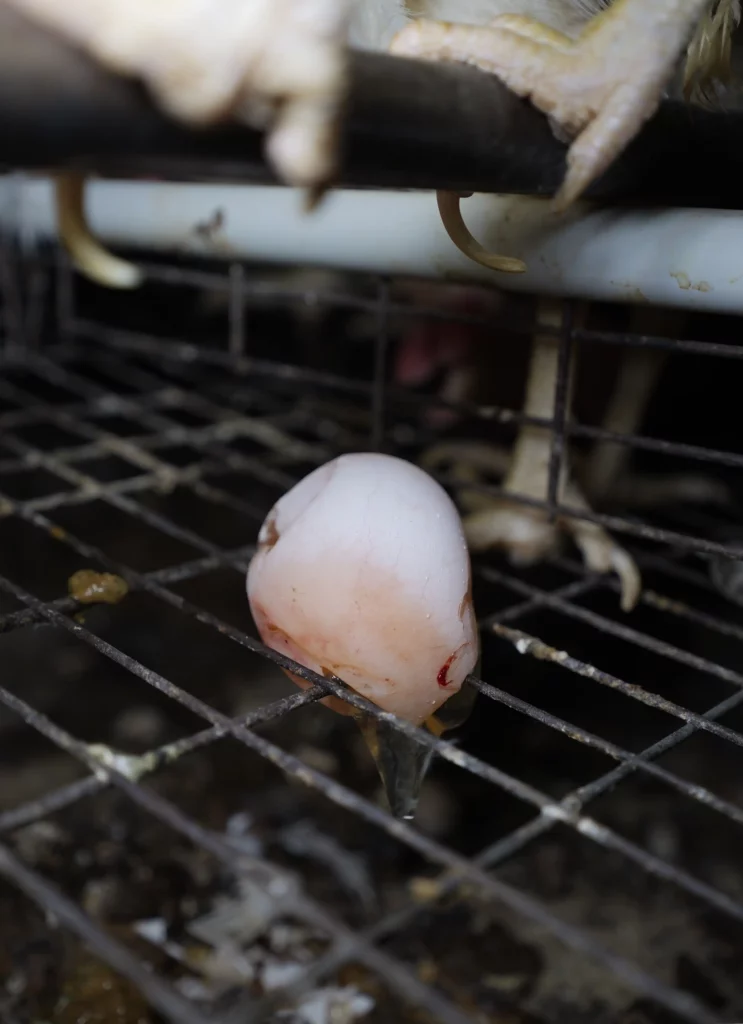
Battery cage
And this is why there are still billions of laying hens farmed worldwide to ensure a constant supply.
Despite ethical doubts regarding the deprivations and suffering endured by the animals, and the tangible risk that these farms represent for the spread of epidemics like avian flu, the numbers do not stop.
Just think that, in the first 8 months of 2023, in Italy, there were about 2,800 laying hen farms, where over 41 million heads were confined.
Of these, 36% were kept in a method considered to date the most cruel: battery cage².
Precisely while you are reading these lines, all those animals continue to be crammed into narrow, dirty, and overcrowded spaces.
It has been calculated that the surface area available to each of them corresponds to an A4 sheet of paper, a space decidedly insufficient to express even basic ethological needs, such as opening their wings or raising their heads completely.
Over the years, dozens and dozens of associations worldwide, counting on the support of a part of the political sphere, have conducted and continue to conduct awareness campaigns so that the use of cages (for poultry, as well as for other species) is eliminated from farms.
But, despite promises from both sector representatives and competent political bodies, a revision of legislation on animal welfare is slow to arrive.
As in Europe, where, even for 2026, the European Commission’s agenda notably lacks references to legislative proposals of this kind. An absence that weighs even more heavily, given that the commitment made to citizens (who are very sensitive to the topic) had a deadline of 2023³.
The Real Cost of Eggs
In June 2025, the Open Wing Alliance (OWA) launched, in collaboration with We Animals, a global investigation titled “The Real Cost of Eggs”, involving 37 countries and six continents to document the hidden reality behind the global egg production system. From Africa to Oceania, passing through Asia, Europe, and America. In all investigated farms, in every country or continent where what is currently the largest investigative work on the topic was conducted, heavy irregularities and negligence emerged, along with environmental criticalities and an unjustified, intolerable indifference towards animal suffering.

And in Italy?
The work carried out together with We Animals made it possible to provide precious testimony regarding what happens on our territory. The findings, publicly disseminated by the Food For Profit network, go far beyond imagination.
The images, dating back to April, May, and June 2025, come from two intensive laying hen farms, both located in Lombardy.
In the larger of the two, with about 300,000 animals, the certainly most serious fact is the discovery of a sheep carcass, in an advanced state of decomposition, in the filter zone of one of the sheds—a place where cleanliness and hygiene should be respected perhaps even more than elsewhere.
The animal has no ear tags, and its condition suggests it has been there for several weeks. Some hens were filmed roaming freely in this area, outside the barns.
Episodes of this kind denote superficiality and recklessness in site management and are particularly serious in a moment like the one we are living in, where the whole world is on alert for the spread of the avian flu epidemic.
Contact with wild animals is one of the most common causes of spread, and propagation in places as densely populated as intensive farms is extremely fast.
The virus, moreover, has already undergone several mutations, managing to infect mammals as well, and the danger that it could make the final jump—becoming transmissible from person to person—is not to be underestimated⁴.
Thanks to what was filmed inside the sheds, several criticalities emerged, both relating to phenomena of neglect towards the animals and regarding biosecurity.
The hens show significant feather loss due to continuous rubbing against the metal cage wires and stress, which drives them to mutual aggression and self-harm phenomena.
Several of them present significant anal prolapses, a condition that causes intense suffering. Despite this, they are left next to the others and, in all likelihood, will not receive care.
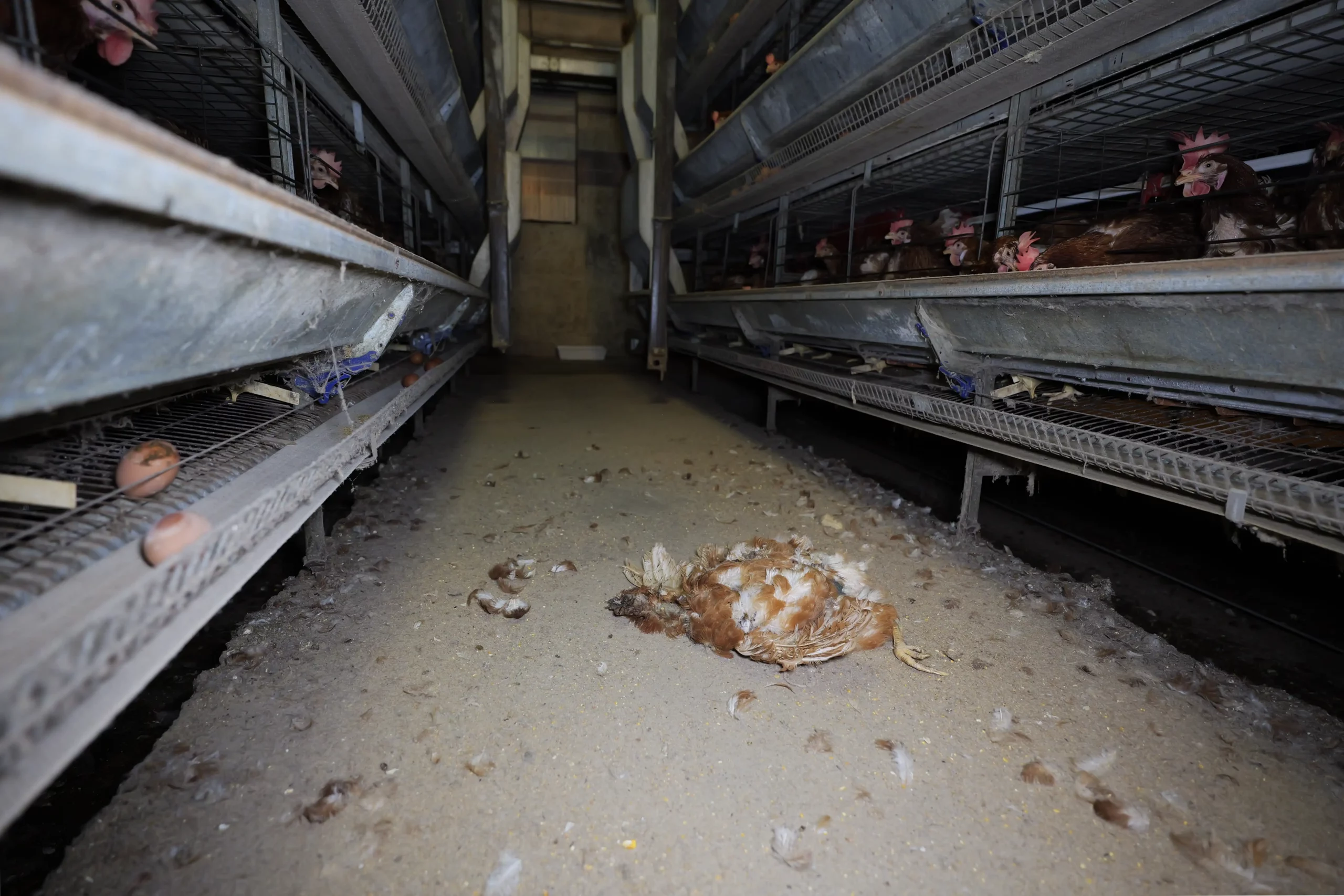
The site presents very serious structural and hygienic deficiencies, with very dirty cages, eggs, animals covered in feces, and carcasses abandoned, even for several days, among the live animals, which, in some cases, have led to episodes of cannibalism.
Abandoned Carcasses and Cannibalism – Not an Isolated Case, but Recurring Irregularities
The cages are stacked one on top of the other. Dozens of plucked necks protrude from the metal nets. In the second site, the sense of oppression and anguish seems evident.
The spaces are extremely dirty; droppings accumulated on the upper levels inevitably fall onto those below, even onto the other animals. A hen, probably bored and stressed, eats the feces it finds on the floor.
he hens, apparently young, are already visibly worn out by the conditions of detention: the neck is almost always plucked due to the need to feed through the bars, stereotypies are very widespread, and difficulties in moving are evident, also due to perches that, in numerous cases, are particularly worn out.
The mechanical system for filling the troughs seriously risks injuring the animals at every passage.
Even in this farm, carcass disposal represents a critical issue. Instead of being promptly removed, as regulations require, they are left abandoned in the aisles or, as seen in the footage, inside the cages themselves for several days. Some of these have been there for so long that they have reached a state of mummification.
Conclusions
The findings paint a situation dangerous for animals, but also for human beings, which could potentially explode at any moment. The high density of heads, poor hygiene conditions, and biosecurity criticalities make intensive farms places where viruses find ideal locations for propagation.
The incorrect behaviors of some sector operators can overwhelm the entire community, causing incalculable damage. For years now, important scientists from all over the world have spoken of avian flu as the next pandemic, underlining that there is no longer an IF, but a WHEN the virus will make the final mutation, i.e., the one necessary to shift its preference to human-type receptors. Ergo, it will be transmissible from person to person.
The risk seems very concrete, to the point that in March 2025 a group of scientists published an appeal in the journal Science⁵, eurging governments, industry, and the scientific community to urgently prepare for a potential pandemic by developing vaccines, drugs, and effective communication plans.
Furthermore, the economic damage that all European countries, Italy included, have had to face in recent years as a consequence of the spread of various zoonoses must also be considered. Huge sums of money, taken from taxpayers’ coffers, have been (and continue to be) granted to intensive farms as compensation for damages caused by the epidemic of the moment. The numbers are impressive: for the months from January 2022 to May of the same year, the total amount of aid, co-financed 50% between the European Union and Italy, amounts to €93,341,580.00⁶.
But, instead of learning from mistakes made and acting in ways that are truly effective to change course, we continue to preserve and finance a sick and unsustainable model, based on hyper-consumption and the hyper-exploitation of resources.
So, is it really true that an egg never hurt anyone?
The investigation “The Real Cost of Eggs” had a very strong echo, thanks also to its global dissemination.
More than one hundred international celebrities signed an open letter, asking companies to interrupt commercial relationships with farms that use the battery cage system.
In more than one country, the investigated facilities were fined or legally prosecuted due to poor management and irregularities found.
Regarding Italy, a formal complaint was filed with the Forestry Carabinieri of Lodi for one of the sites involved. It was filed by reporter Giulia Innocenzi, who handled the exclusive dissemination of the investigation’s findings through the Food For Profit network and Corriere della Sera. The opening of an investigation has been confirmed, which is in its preliminary phases (ex art. 415 bis cpp), demonstrating that criminal proceedings have been initiated.