
at a major producer’s facility
Animal welfare.
An increasingly overused term.
It is heard more and more often from livestock sector representatives and politicians, or inserted into advertising campaigns.
But does it really make sense to use it when talking about intensive farms or, more generally, the entire livestock industry?
Is it plausible that companies raising millions of animals to sell their meat or derivatives can meet standards such that they can be equated with the concept of welfare?
First of all, it must be emphasized that the term itself is still evolving, subject to studies, modifications, and adaptations to new realities and the degree of sensitivity and awareness that societies have acquired over time.
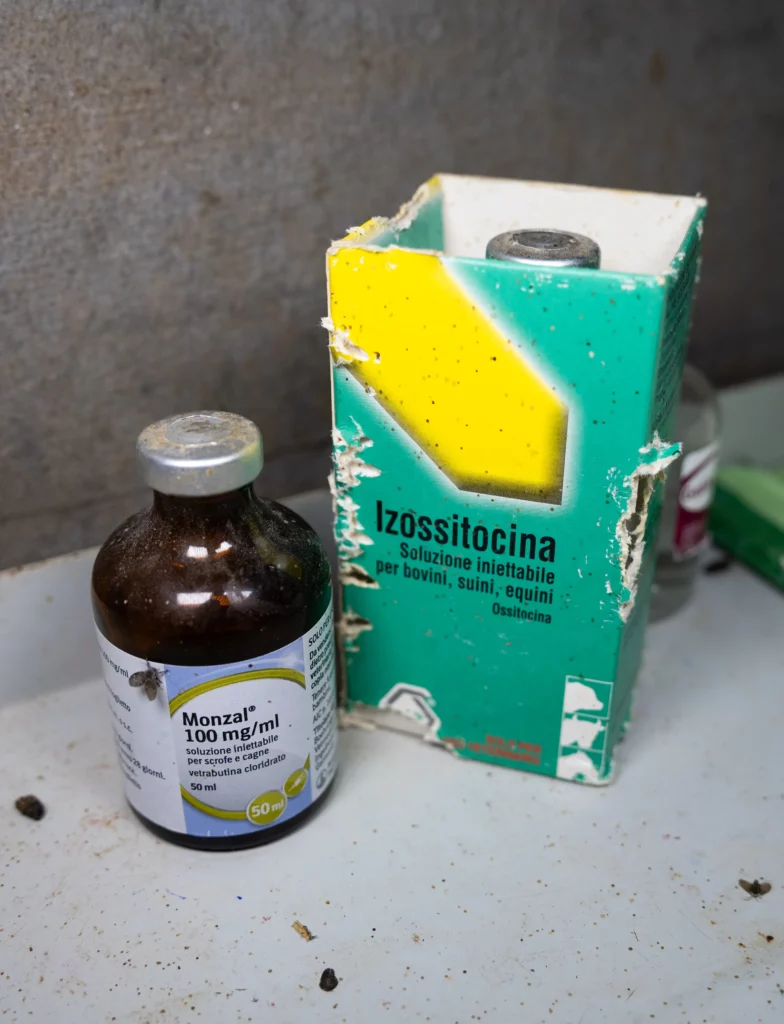
In the post-WWII era, technological innovation heavily imposed itself, reshaping livestock production models in Europe. This led to a significant worsening of animal living conditions (higher number of heads, genetic selection, massive use of antibiotics even preventively).
The situation came to light in England thanks to the investigative work of journalist Ruth Harrison, followed by the drafting of a document by a commission of experts appointed by the British government to define minimum protection criteria for farmed animals. It was 1965, and with the Brambell Report, the concept of ‘animal welfare’ was effectively born, understood as the absence of deprivation of fundamental freedoms. The document then became the foundation for subsequent regulations promulgated in the European Union on this topic.
Since then, legislation has been and continues to be at the center of numerous ethical and scientific debates.
The theme of animal welfare is still a subject of discussion and is, certainly, one of the pillars on which many livestock players base their communication.
Some sector leaders, the pride and joy of the so-called Made in Italy, have even mentioned it in their Sustainability Reports, citing respect for animals and their responsible care as primary conditions for raising them.
The doubt, legitimately raised, concerns the real motivation behind such initiatives: whether they stem primarily from the commercial need to reassure consumers increasingly sensitive to the issue, or whether they are the fruit of an authentic ethical commitment, aimed at conforming to a model more respectful and coherent with the species’ ethology.
In the following investigation, carried out in collaboration with Greenpeace, a very important intensive production site was analyzed, linked to a prominent name ranking among the top three in Italy for annual revenue (a figure well exceeding 1.5 billion)¹and among the top fifty recipients of the most substantial Common Agricultural Policy (CAP) funds².
The same company also ranks among the top generators of ammonia (in 2023 among the top twenty) and methane (among the top ten)³.
Let’s see, specifically, what was found.
Rats, untreated wounds, and abandoned carcasses: Made in Italy goes to the table
The facility specializes in breeding piglets for weaning; that is, it manages pregnant and farrowing sows, then sending the piglets to other sites where they will be fattened and finally destined for the slaughterhouse.
In weaning centers, everything natural that could be associated with pregnancy and birth disappears. The mother/offspring relationship is mechanically reduced to the moment of nursing. There is not enough space to do anything else, and the sows, although confined in cages of a few meters, are not always able to avoid crushing their newborn piglets. Others are born dead, and the mortality rate recorded in these sites is, in fact, always very high.
The images show many piglet carcasses, some of which are even mummified, a sign suggesting they remained there, in the pens next to the live ones, well beyond the 24 hours established by regulations for removal. This practice is dangerous from a sanitary point of view, as it exposes live animals to contact with dead ones, whose cause of death is mostly unknown.
Furthermore, it represents a critical issue also from the perspective of respecting the animal’s ethology. Pigs are very sensitive, establishing strong family bonds, and leaving carcasses in continuous visual and olfactory contact exposes the sow to severe emotional stress.
Inside the barns, there is an evident rat infestation problem; in some videos, rats were filmed right inside the pens, in direct contact with the animals present. But the apparently most serious problem is recorded in an area where some sows aborted piglets, which were then bitten or even eaten by rodents.
The danger extends not only to the pigs confined on the site but also to the personnel working there and, ultimately, to the consumers themselves.
Live rats, through their droppings, or dead ones not removed, can transmit diseases such as salmonellosis, leptospirosis, and toxoplasmosis. Moreover, as already documented in other investigations, if pigs were to bite or eat those killed by rodenticide (often used to contain infestations), this could remain in the meat even after slaughter⁴. Thus, ending up on our tables.
Some of the sows present on the site have lacerations caused by the bars of the farrowing crates, where they continuously bang due to stress or the lack of space suitable even for the simplest movements like lying down or standing up. Many of these wounds appear visibly untreated with disinfectant spray, essential to prevent infections. Such omission, in the most serious cases, represents a serious irregularity in animal management.
Others, inside the farrowing pens, have untreated uterine prolapses.
One of them, in the most critical situation, has her uterus practically completely protruding and is forced to continue nursing her piglets even in this state.
It is a condition that causes great suffering and is potentially lethal if internal hemorrhaging also occurs. It affects especially the older ones, who have been forced to give birth dozens of times throughout their lives.
Several cut tails were found along the corridors..
This practice should occur only and exclusively in cases of absolute necessity, when no other solutions can be adopted⁵. In reality, however, it happens routinely because there is no other effective way to prevent animals from attacking each other due to the stress generated by such densely populated environments, and the extremities (tail, ears) are the first to be attacked by other animals.
It is a very painful operation and is performed without anesthesia on piglets in the first days of life (regulations establish within the first 7 days, but this is not always respected).
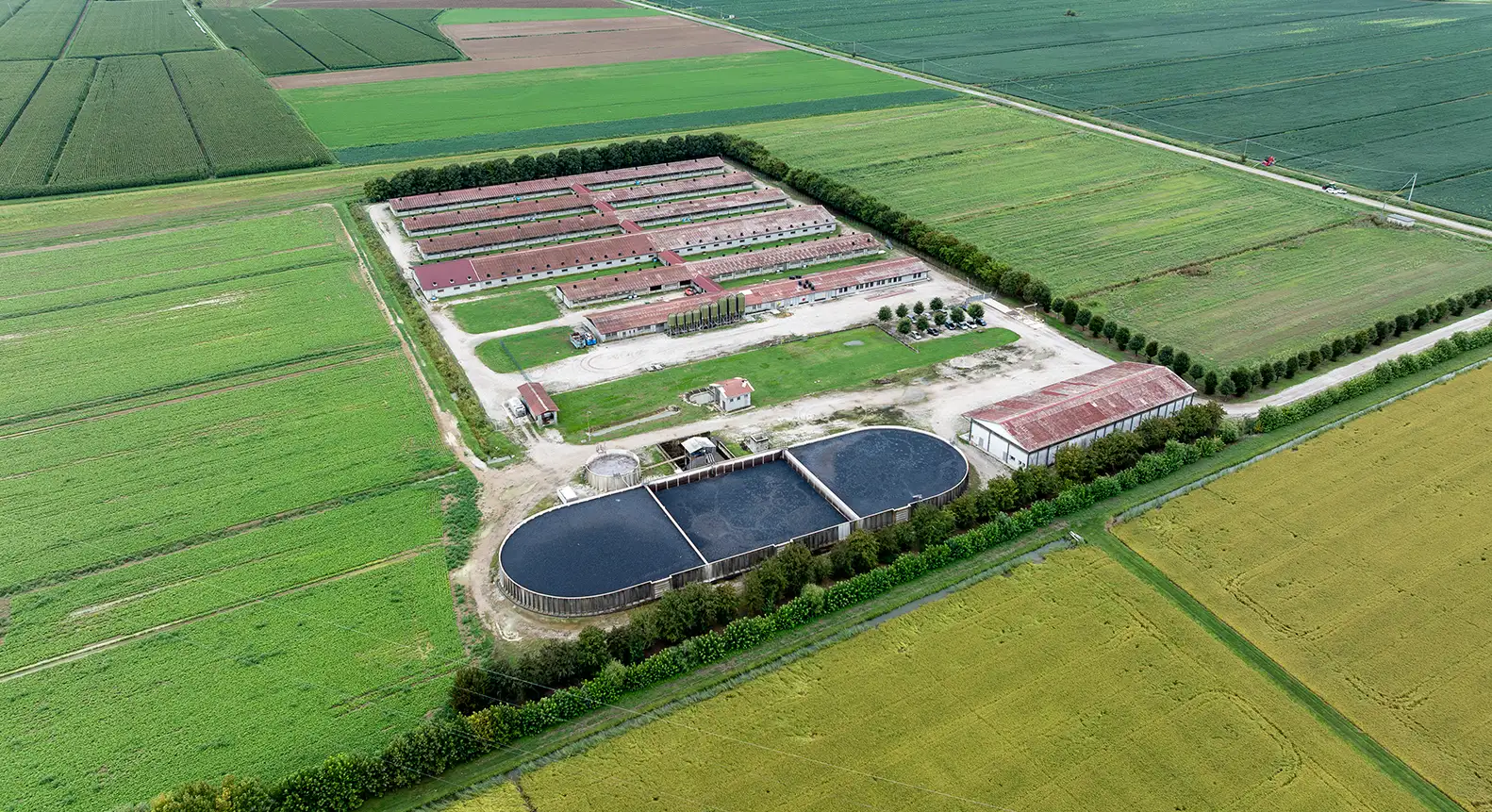
Finally, the site also presents serious deficiencies regarding waste disposal.
Thanks to aerial footage, it was possible to document a large leak of slurry, feces, and pig urine that ends up, in part, on the ground. Although contained within the company perimeter, it represents a concrete pollution risk for the surrounding soil and water bodies.
Thanks to the findings obtained, it was possible to analyze what happens inside the site, and the reality is far from what is declared in the Sustainability Report, namely that “respect for animals and their responsible care are primary conditions for raising them.“.
The very concept of animal welfare, when applied to the intensive farming model, generates a veritable cognitive “short circuit,” as the animal is confined in spaces inadequate to its nature and deprived of the possibility to express innate behaviors and fundamental needs of its species.
This investigation has demonstrated and further confirmed the unsustainability of a system that, to satisfy market demand, presupposes brutal methods responding to a single value: that of profit.
How it ended
Following the complaint filed with the Prosecutor’s Office of Mantua by the association Greenpeace Italy, requesting investigations on the site under scrutiny, the local Carabinieri and the NAS (Health Police) of Cremona inspected it.
Serious violations were detected regarding the management of the farm in terms of biosecurity and animal welfare.
In November 2025, the ATS of Valpadana placed the animals present in the company under seizure and imposed a maximum fine of 10,000 euros on the legal representative of the agricultural company.