
an exposé with Greenpeace
We are inside a large intensive farm. Abandoned on the floor lies the carcass of a pig. Judging by its state of decomposition, it may have been dead for several days.
It is in a pen with other live animals that sniff it, observe it, and begin to bite it. At first, it almost seems like a game; they launch small attacks before retreating.
In an instant, however, the situation degenerates. In a state of growing agitation and collective stress, one of them buries its snout in the flesh and begins to cannibalize the carcass. The others immediately follow suit.
The animals eating this visibly decomposing meat are the same ones that will end up at the slaughterhouse and, subsequently, on consumers’ tables. The risk of potential contamination is enormous.
What is described here is just one of the episodes documented in an investigation carried out in collaboration with Greenpeace, which paints a worrying picture of the management of an intensive site in Emilia-Romagna.

Not just any farm
We are in Bondeno, in the province of Ferrara. The company in question is linked to a highly renowned group in the livestock sector, already owner of some of the most famous brands in the industry. It is a rather large contract farming operation (soccida), which, at full capacity, would manage up to 20,000 weaned and fattening pigs¹.
The ownership is no stranger to Greenpeace.
Since 2019, in fact, the environmental association had organized several protests with local citizens against the expansion or construction of new sites linked to the group, successfully stopping a new mega-farm for 10,600 pigs in Schivenoglia (Mantua, Lombardy)².
In 2023, the group in question, with its 74,810 kilotons of ammonia emissions, ranked fifteenth in a list of about 800 Italian companies within the E-PRTR, a European register collecting annual data on emissions of over 90 pollutants into the air, water, and soil from approximately 4,000 industrial plants in Europe³.
In 2024, one of the group’s companies was also featured in an investigation aired on the Report program on Rai 3. The site had been hit by African Swine Fever (ASF) during the epidemic that had raged in those areas. Aerial images, released by the Food for Profit network and supervised by some members of the Unlocked team, highlighted the controversial methods used for stamping out (the culling of all animals, mandatory in such cases).
Rats, injured or sick pigs, and carcasses abandoned in pens: is this the standard for big players in livestock farming?
The findings come from several sheds on the site; in all of them, poor hygienic and sanitary management was evident.
The corridors, as well as the pens where the animals are confined, are full of rats. A true infestation that spares no corner: from the food troughs to the corridors and into the pens themselves. The rodents are in continuous contact with the pigs and their food. Even some dead rats, in an advanced state of decomposition, are clearly visible inside the enclosures. Standard procedure would require their removal within a maximum of 24 hours to avoid possible contamination, which, in this case given the species, would be very dangerous. Rodenticide is present, but instead of being collected in specific containers, it has been scattered throughout the farm. In this way, the pigs themselves could ingest it, and consequently, the meat sold after slaughter could contain traces of it⁴.
The animals in the pens do not appear to be in optimal condition at all: they have reddened eyes and skin, likely due to the high concentration of ammonia in the air and the fact that they are in continuous contact with feces and urine, which cover the flooring.
Umbilical hernias are also quite frequent, as well as open wounds on various parts of the body, caused particularly by attacks from other pigs. They indeed seem very stressed, and attacks are documented in multiple clips. In one case, a visibly sick pig is lying on the ground in a fattening pen and is repeatedly bitten, as is another specimen, which has a large, open, infected wound around the anus, covered in insects. Both, given their condition, should have been moved to a dedicated space, indicated as an infirmary, to receive adequate care. Instead, they are left at the mercy of the animals with which they share the pen, becoming easy targets.
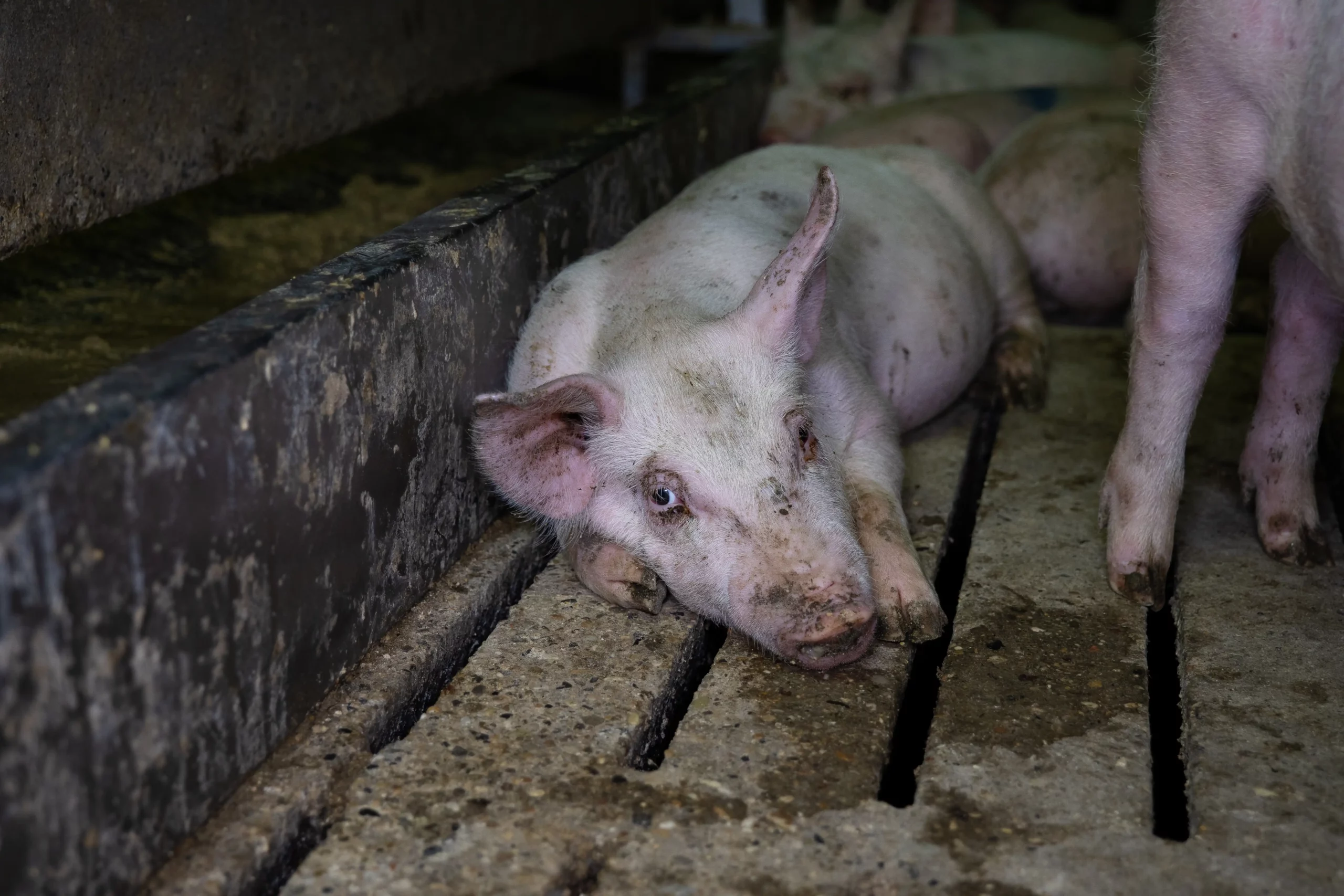
Aggression is frequent in these structures. It is a consequence of frustration, generated in turn by the failure to satisfy the species’ ethological needs.
As proof of this, many lacerations are visible, especially on tails—which are already docked precisely to prevent pigs from biting each other—or on ears.
Even in cases where a significant ongoing infection is visible, there seem to be no signs of any medical treatment, and the animals, instead of being moved to a specially designated place, remain in the pens with the others, under the constant danger of being attacked again.
In all three sheds, as could be seen from the images, carcasses were found. Many were abandoned in the passageways, others inside the pens. As in the case already described at the beginning of the article, where some pigs devour the entrails of a specimen that has been dead and decomposing for some time.
“A terrible scene, truly on the verge of being narratable. It is not rare to witness episodes of this kind; cannibalism is, unfortunately, a common occurrence among animals confined in these structures. Stress, the absence of adequate stimuli, and the forced sharing of already very limited spaces lead them to aggression, which sometimes degenerates. But in this case, things went beyond that.“.
Those who analyzed the images describe it as one of the most gruesome events they have ever witnessed, highlighting its dangerous nature, also in terms of biosecurity.
In fact, the pigs eating this potentially contaminated meat are the same ones that will go to the slaughterhouse, thus ending up in the food supply chain.
The findings highlight a very serious situation: major flaws in terms of biosecurity, deficiencies, and irregularities regarding the standards, even the minimum ones, required in terms of animal welfare.
If such an important company, with great financial availability like the one under investigation, cannot or will not follow the rules, one wonders what happens in all those with much lower revenues and smaller dimensions.
The release of the investigation caused a major stir and was picked up by several national and local media, including Corriere della Sera, Il Resto del Carlino, and RaiNews.
On Instagram, a video dedicated to the investigation, a collaboration between the Food For Profit network and Greenpeace Italy, generated 1 million views.
Despite the media clamor and public outrage, the company has not yet replied nor provided explanations regarding what was found in the farm under its responsibility.